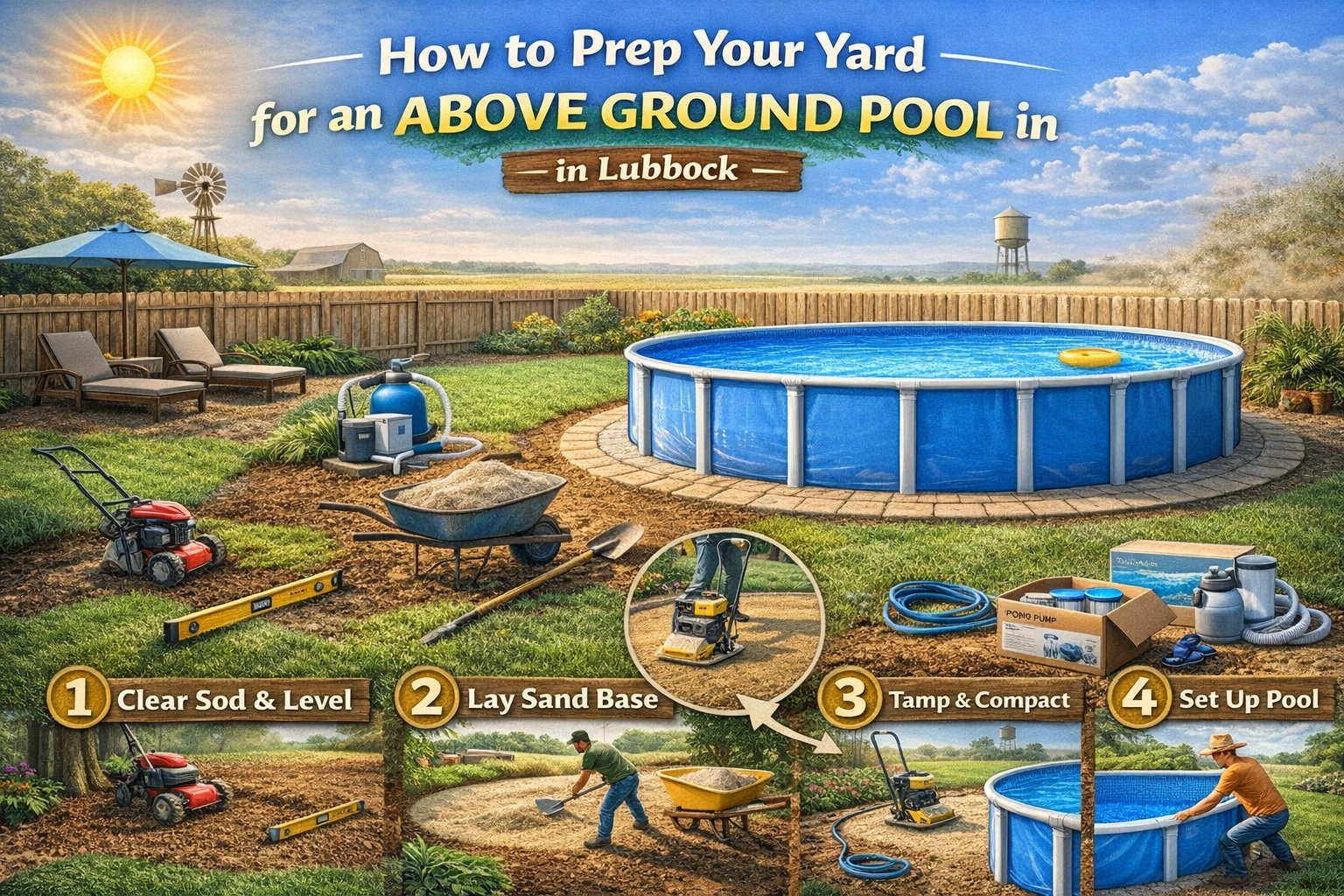
Summer in Lubbock means one thing for a lot of families: it's pool time. And with above ground pools from Walmart, Target, Sam's Club, and Amazon running anywhere from $200 to $1,500, it's never been easier to drop a pool in your backyard. Intex, Bestway, Summer Waves — pick one, bring it home, fill it up, and you're swimming by the weekend. Right?
Not quite. The number one reason above ground pools fail — leaning, collapsing, liner tears, water that looks like a swamp within a week — is bad ground prep. And Lubbock's soil makes this worse than most places. Our clay-heavy, caliche-riddled ground doesn't drain well, doesn't level easily, and shifts when it gets wet. Skip the prep and you'll be fighting that pool all summer.
Here's how to do it right, step by step.
Step 1: Choose the Right Spot
Before you do any digging, walk your yard and think carefully about where this pool is going. The location you pick determines how much prep work you'll need and how well the pool holds up over the summer.
What to look for
- Flattest area available. Even a 2-inch slope across a 15-foot pool means one side has significantly more water pressure than the other. The flatter you start, the less leveling you'll need to do.
- Full sun. In Lubbock, this isn't hard to find. But you want sun on the pool — it keeps the water warm naturally and reduces algae growth compared to a shaded, stagnant pool.
- Away from trees. Mulberry trees are the worst offenders in Lubbock — they drop berries that stain liners and clog filters. Mesquite drops tiny leaves constantly. Elm sheds in spring. Give yourself at least 15-20 feet from any tree canopy.
- Away from the house foundation. If the pool leaks or overflows, you don't want thousands of gallons of water saturating the soil next to your foundation. Keep at least 10 feet away.
- Access to a water source and electricity. You'll need a hose to fill it and a nearby outlet for the filter pump. Running extension cords across a wet yard is a safety hazard — plan for a proper setup.
- Drainage slope away from the pool. The surrounding ground should slope away from the pool area so rainwater doesn't pool around the base.
Check before you dig. Call 811 (Texas One-Call) before you start any digging to have underground utility lines marked. It's free, it's required by law, and hitting a gas or water line is no way to start the summer.
Step 2: Clear and Mark the Area
Once you've picked your spot, you need to prep the ground. Start by clearing everything in the pool footprint plus 2 feet on all sides. That means removing all grass, weeds, rocks, roots, and debris down to bare dirt.
Mark the area. For a round pool, drive a stake in the center, tie a string to it the length of the pool's radius plus 1 foot, and walk the perimeter with a can of spray paint. For a rectangular pool, use stakes and string to mark the corners and snap chalk lines.
Remove the grass. Use a flat shovel or sod cutter to strip the grass and its root layer — about 2-3 inches deep. Don't just mow it short and put the pool on top. Grass under the pool will die, decompose, create odor, attract bugs, and make the ground uneven. This is the step most people skip, and it always causes problems.
Step 3: Level the Ground
This is the most important step and the one most people underestimate. A pool that's off-level by even 1-2 inches creates uneven water pressure on the walls. On a 15-foot round pool holding 3,500+ gallons, that's hundreds of pounds of extra force on the low side. Over a few weeks in Lubbock heat, that stress warps the frame, stretches the liner, and can cause a blowout.
The rule of thumb: Your pool area should be level to within 1 inch across the entire diameter. For a 15-foot pool, that means less than 1 inch of variation across 15 feet. It sounds extreme, but water always finds level — and when it does, the side that's too low takes all the extra weight.
How to level Lubbock soil
Always dig down, never build up. The biggest mistake people make is adding dirt to the low side to bring it up to the high side. Filled-in dirt settles unevenly over time — especially when thousands of gallons of water are sitting on top of it. Instead, scrape the high side down to match the low side. You're looking for a flat, undisturbed soil surface.
Use a long level. A 4-foot level on top of a straight 2x4 (8 feet long) gives you a good span to check. Place it across the area in multiple directions — north-south, east-west, and diagonally. Check frequently as you work.
Watch for caliche. If you hit a hard white layer while digging — that's caliche, Lubbock's signature calcium carbonate deposit. It's like hitting concrete. You may need a pick or mattock to break through it. If the caliche layer is relatively flat, you can sometimes work with it as your base since it won't shift. If it's uneven, you'll need to break down the high spots.
Compact the soil. Once level, tamp the entire area firmly. You can rent a hand tamper or plate compactor from a local rental shop. Loose, fluffy soil will compress unevenly under the pool's weight and create dips and low spots within days.
Step 4: Build the Sand Base
A sand base does three things: it gives you a final leveling layer, it cushions the pool liner from rocks and roots below, and it creates a smooth, comfortable surface underfoot.
Choose the right sand
Use masonry sand (also called "play sand" or "pool sand") — not paver base, not river sand, not fill sand. Masonry sand is fine-grained, compacts well, and creates a smooth surface. You can pick it up by the bag at Home Depot or Lowe's, or order it by the cubic yard from a Lubbock sand and gravel supplier (much cheaper for larger pools).
Calculate how much you need
You want a 2-inch layer of sand across the entire pool footprint. For a 15-foot round pool, that's about 1.5 cubic yards (roughly 2 tons). For a 12-foot round pool, about 0.9 cubic yards. For a 10x20 rectangular pool, about 1.2 cubic yards. Order a little extra — you can always use leftover sand elsewhere in the yard.
Spread and level
Dump the sand onto your leveled soil and spread it evenly to a 2-inch depth. Use a garden rake to distribute it, then use a straight 2x4 as a screed board to flatten it. Drag the board across the surface in overlapping passes. Mist the sand lightly with a hose to help it settle, then tamp it flat.
Final level check
Run your level across the sand base in every direction. This is your last chance to get it right. Scrape down any high spots and fill low spots. The sand should feel firm underfoot — if you leave deep footprints when you walk on it, tamp it more.
Step 5: Lay a Ground Cloth
Before the pool goes on, lay a ground cloth or tarp over the sand. Most above ground pools come with a thin ground cloth, but it's worth upgrading. A heavy-duty tarp or purpose-made pool ground cloth protects the liner from any small rocks, roots, or debris that work their way up through the sand over the summer.
Cut it to the size of the pool's footprint — you don't want excess material bunching up under the pool or sticking out from under the edges where it collects water and breeds mosquitoes.
How Heavy Is This Thing, Actually?
People underestimate how much water weighs. Here's what you're putting on your ground:
| Pool Size | Gallons (approx.) | Water Weight | Total with Pool |
|---|---|---|---|
| 10 ft round, 30" deep | 1,185 gal | 9,880 lbs | ~10,000 lbs |
| 12 ft round, 30" deep | 1,718 gal | 14,330 lbs | ~14,500 lbs |
| 15 ft round, 48" deep | 4,440 gal | 37,030 lbs | ~37,200 lbs |
| 10x20 ft rect, 48" deep | 4,120 gal | 34,360 lbs | ~34,600 lbs |
That 15-foot round pool from Walmart? It's sitting on your yard with nearly 19 tons of weight. That's why level, compacted ground matters so much. Soft spots compress, the frame shifts, and you've got a problem.
Lubbock-Specific Considerations
Soil expansion and contraction
Lubbock's clay soil expands when wet and contracts when dry. Under a pool that's constantly leaking small amounts of splash-out and condensation, the soil around the edge stays wetter than the soil further away. Over the summer, this can create a subtle "bowl" effect where the perimeter sinks slightly. It's usually not dramatic enough to cause a failure, but if you're on heavy clay, compacting the base thoroughly and using the sand layer helps minimize this movement.
Wind
An empty above ground pool in a Lubbock windstorm is a sail. If you ever need to drain the pool, don't leave it standing empty — partially collapse it or weight it down. A 30-40 mph gust (which we get regularly) can pick up an empty pool frame and send it into your fence, your neighbor's yard, or worse.
Evaporation
You'll lose 1-2 inches of water per week in Lubbock summer to evaporation alone — more on windy days. A pool solar cover (the "bubble wrap" kind) reduces evaporation by 90% and also keeps the water warmer. At Lubbock water rates, a cover pays for itself within weeks.
City of Lubbock regulations
Above ground pools generally don't require a building permit in Lubbock, but check your HOA covenants if you have them. The city does require that pools (including above ground) be enclosed by a barrier if they hold water deeper than 24 inches. Your existing backyard fence may satisfy this, but it's worth confirming. The barrier must be at least 48 inches tall with self-closing, self-latching gates.
Common Mistakes to Avoid
- Setting the pool on grass. The grass dies, decomposes, creates gas bubbles under the liner, and makes the ground uneven. Always strip to bare dirt.
- Adding fill dirt to level. Dig down, don't build up. Fill dirt settles unevenly under weight.
- Skipping the sand base. Bare dirt has small rocks, roots, and debris that will puncture the liner. The sand is cheap insurance.
- Not compacting. Loose soil and loose sand will compress unevenly in the first few days after filling. Tamp everything before the pool goes on.
- Putting it too close to the fence. You need room to walk around all sides for maintenance, and you don't want splash-out rotting your fence boards.
- Ignoring drainage. After a Lubbock thunderstorm, where does the rainwater go? If the answer is "right where the pool sits," you need to rethink the location or add some drainage grading around it.
What You'll Need — Quick Shopping List
- Masonry sand: 1-2 cubic yards depending on pool size (see calculations above)
- Flat shovel and sod cutter or spade for removing grass
- Garden rake for spreading sand
- Long straight 2x4 (8-10 feet) for screeding sand
- 4-foot level
- Hand tamper or plate compactor (rent from a local hardware store)
- Heavy-duty ground cloth or tarp
- Spray paint for marking the perimeter
- Stakes and string for layout
Or Let Us Handle It
Not everyone has a free weekend and the tools to scrape, level, and sand a pool pad. At 3D Landscaping and More, we do pool site prep for Lubbock homeowners — from clearing the grass to leveling the ground to laying a compacted sand base ready for your pool. We can also handle the drainage grading around the area so rainwater flows away from the pool and your foundation.
By the time we're done, all you have to do is unbox the pool and fill it up.
Ready for Pool Season?
Get a free quote for pool site prep — leveling, sand base, ground clearing, and drainage grading anywhere in the Lubbock area.
Request a Free Quote