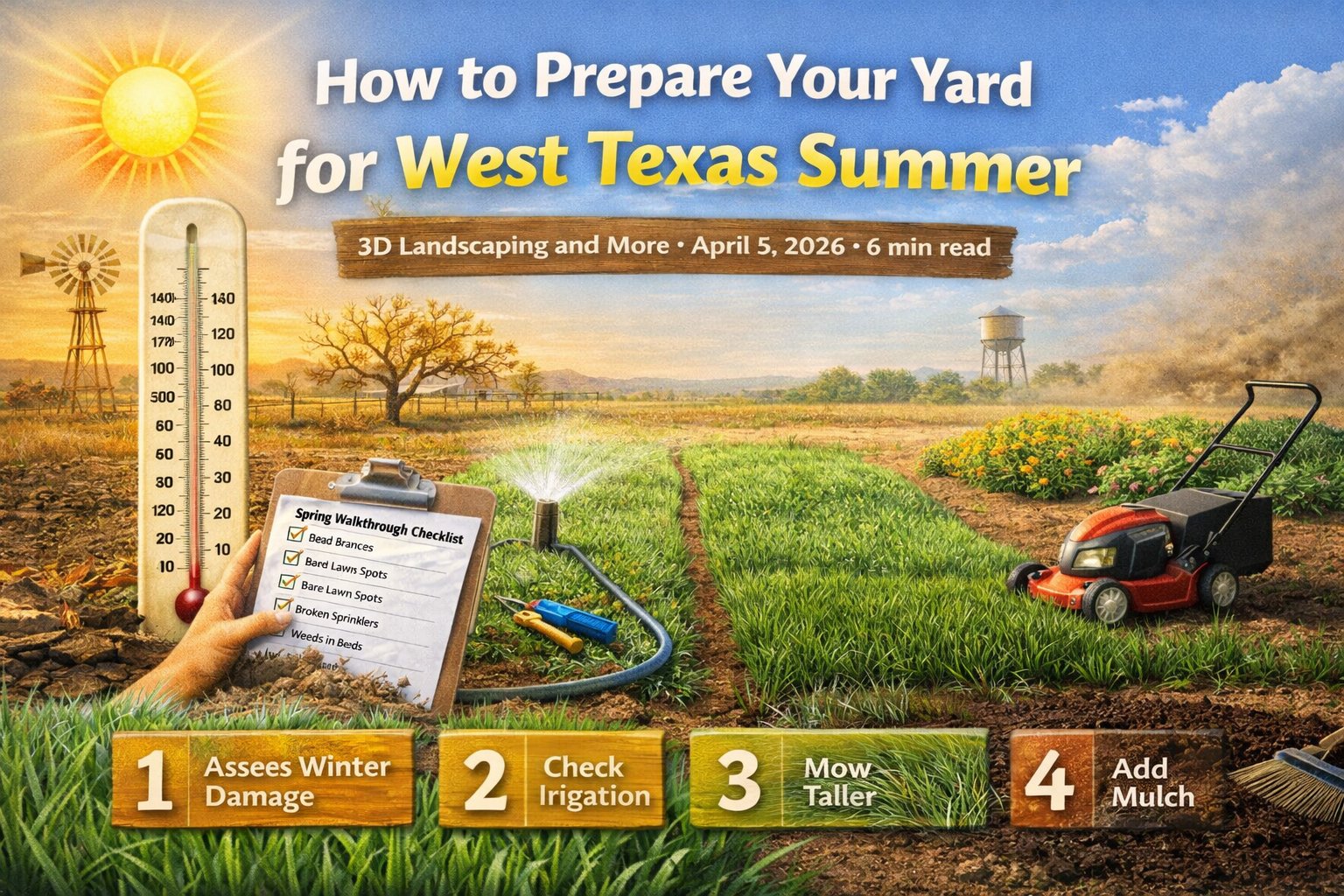
Summer in Lubbock doesn't ease in — it arrives. One week you're enjoying 75°F spring evenings, and the next it's 100°F with wind that feels like a hair dryer. If your yard isn't prepped for that transition, you'll spend the rest of the summer playing catch-up with brown grass, stressed plants, and a water bill that makes you wince.
The good news is that a few hours of intentional prep in late April and May can save you months of headaches. Here's exactly what our crews do to get Lubbock properties summer-ready — and what you can do on your own yard this spring.
Step 1: Assess the Damage from Winter
West Texas winters are unpredictable. Some years we get a hard freeze that damages shrubs and irrigation lines; other years it's mild and dry. Before you do anything else, walk your property and take stock.
Spring Walkthrough Checklist
- ✓ Check for dead or damaged branches on trees and shrubs — prune before new growth starts
- ✓ Look for bare or thin spots in the lawn — these need reseeding or patching
- ✓ Test your irrigation system — run every zone and watch for broken heads, leaks, or uneven coverage
- ✓ Check flower beds for weed growth — pull early before they seed
- ✓ Inspect mulch depth — if it's below 2 inches, plan to replenish
- ✓ Look for erosion or washout areas from winter rain or snow melt
Step 2: Get Your Irrigation Right
This is the single most important thing you can do for a Lubbock lawn. With average summer highs above 95°F and often less than 2 inches of rain per month from June through August, your irrigation system is your lawn's lifeline.
Run a full system audit. Turn on each zone one at a time. Walk the yard while it's running. Look for heads that aren't popping up, spraying onto sidewalks or driveways (wasting water), or leaving dry gaps between coverage areas. A single broken head can leave a 10-foot dead patch by July.
Lubbock water tip: The City of Lubbock typically implements a twice-per-week watering schedule in summer. Check the current restrictions before setting your timer. Water between 6-10 AM for best results — morning watering gives the grass time to absorb before the heat, and reduces fungal risk compared to evening watering.
Dial in your schedule. Most Lubbock lawns need about 1 to 1.5 inches of water per week in summer. The catch is getting that water to actually penetrate the soil rather than running off. Our alkaline, clay-heavy soil absorbs water slowly. Run your sprinklers in two shorter cycles (called "cycle and soak") rather than one long one — for example, 10 minutes on, 30 minutes off, then 10 minutes on again. This lets the first round soak in before adding more.
Step 3: Mow Smart, Not Short
One of the most common mistakes we see in Lubbock is mowing the lawn too short heading into summer. It feels like you're being tidy, but you're actually stressing the grass right when it needs to be strongest.
Raise your mowing height. For Bermuda grass (the most common in Lubbock), keep it at 1.5 to 2 inches through summer. For Buffalo grass, 2 to 3 inches. Taller grass shades the soil, reducing evaporation and keeping roots cooler. It also crowds out weeds more effectively than a buzzcut.
Follow the one-third rule: never cut more than one-third of the grass blade height in a single mow. If you've let it get tall, step it down over two or three mowings rather than scalping it.
Keep your blade sharp. A dull mower blade tears the grass rather than cutting it cleanly, leaving ragged tips that brown out and lose moisture faster. Sharpen or replace your blade at the start of each season.
Step 4: Mulch Everything
Mulch is your best friend in West Texas heat. A good 3-inch layer of hardwood or cedar mulch in your flower beds and around trees does three critical things: it holds moisture in the soil, insulates roots from extreme temperature swings, and suppresses weed germination.
Pull existing weeds
Clear all visible weeds from beds before mulching. Mulch suppresses new weeds but won't kill established ones growing underneath.
Edge your beds cleanly
Use a flat spade to cut a clean 2-3 inch trench along bed borders. This keeps mulch from migrating into the lawn and gives a professional, finished look.
Apply 2-3 inches of mulch
Spread evenly, but keep it pulled back 3-4 inches from tree trunks and plant stems. Mulch piled against trunks ("volcano mulching") causes rot.
Water the mulch in
Give the beds a good soak after mulching. This settles the material in place and starts the moisture-retention cycle immediately.
For rock beds (popular in Lubbock xeriscaping), check that landscape fabric underneath is still intact. Over time, wind-blown soil settles between rocks and weeds take hold. Pull the weeds, add a pre-emergent granule, and top off thin areas with fresh rock.
Step 5: Feed Your Lawn — But Wisely
Spring is the time to fertilize warm-season grasses, but timing and type matter. Apply a slow-release nitrogen fertilizer once your Bermuda or Buffalo grass has fully greened up — usually late April to mid-May in Lubbock. Don't fertilize dormant or semi-dormant grass; it can't absorb the nutrients and you'll just be feeding the weeds.
A soil test (available through Texas A&M AgriLife Extension for about $12) will tell you exactly what your soil is lacking. In Lubbock, iron deficiency is common due to our alkaline soil — you may see grass that's green but slightly yellowed. An iron supplement or iron-enriched fertilizer can fix that quickly.
Avoid fertilizing after mid-June. Pushing growth during peak heat stresses the grass and increases water demand at the worst possible time.
Step 6: Pre-Emergent Weed Control
If you didn't apply a pre-emergent herbicide in early March, you may still have a narrow window in early April for a second application. Pre-emergents work by preventing weed seeds from germinating — once you see weeds growing, it's too late for pre-emergent to help with those particular plants.
For Lubbock, the weeds to watch for in summer include crabgrass, sandburs (the bane of every barefoot walk), spurge, and nutsedge. Crabgrass and sandburs can be prevented with a good pre-emergent schedule. Nutsedge requires a targeted post-emergent herbicide — it's a sedge, not a true grass, so regular weed killers don't touch it.
Step 7: Protect Your Trees and Shrubs
Young trees — especially anything planted in the last 2-3 years — are vulnerable in Lubbock summers. Their root systems aren't deep enough yet to access moisture during drought stress. Give them supplemental deep watering once a week with a slow-drip hose at the base. A 5-gallon bucket with a small hole drilled in the bottom works great too.
For established trees, the best thing you can do is avoid compacting the soil in the root zone. Don't park vehicles under trees, and keep the area under the canopy mulched or planted with shade-tolerant groundcover.
Shrubs like Texas Sage, Vitex, and Desert Willow are built for our climate and shouldn't need supplemental water once established. But if you have boxwood, Indian Hawthorn, or other non-native shrubs, plan to water them during extended dry spells.
Your Summer Prep Timeline
- Late March – Early April: Spring walkthrough, irrigation audit, second pre-emergent application, prune winter damage
- Mid-April – Early May: Patch bare lawn spots, begin mowing at summer height, mulch flower beds, fertilize once grass is fully green
- May: Set summer irrigation schedule, edge beds and borders, plant heat-tolerant annuals (lantana, vincas, zinnias)
- June: Monitor irrigation coverage, spot-treat weeds, begin deep watering young trees
Let Us Handle the Hard Part
Getting your yard summer-ready takes time, tools, and know-how. If you'd rather spend your weekends enjoying your property instead of working on it, that's what we're here for. Our crews handle everything from irrigation repair and mulch installation to full seasonal cleanups — all across the Lubbock area.
Get Your Yard Summer-Ready
Request a free quote and we'll put together a summer prep plan tailored to your property. From irrigation to mulch to mowing — we've got you covered.
Request a Free Quote