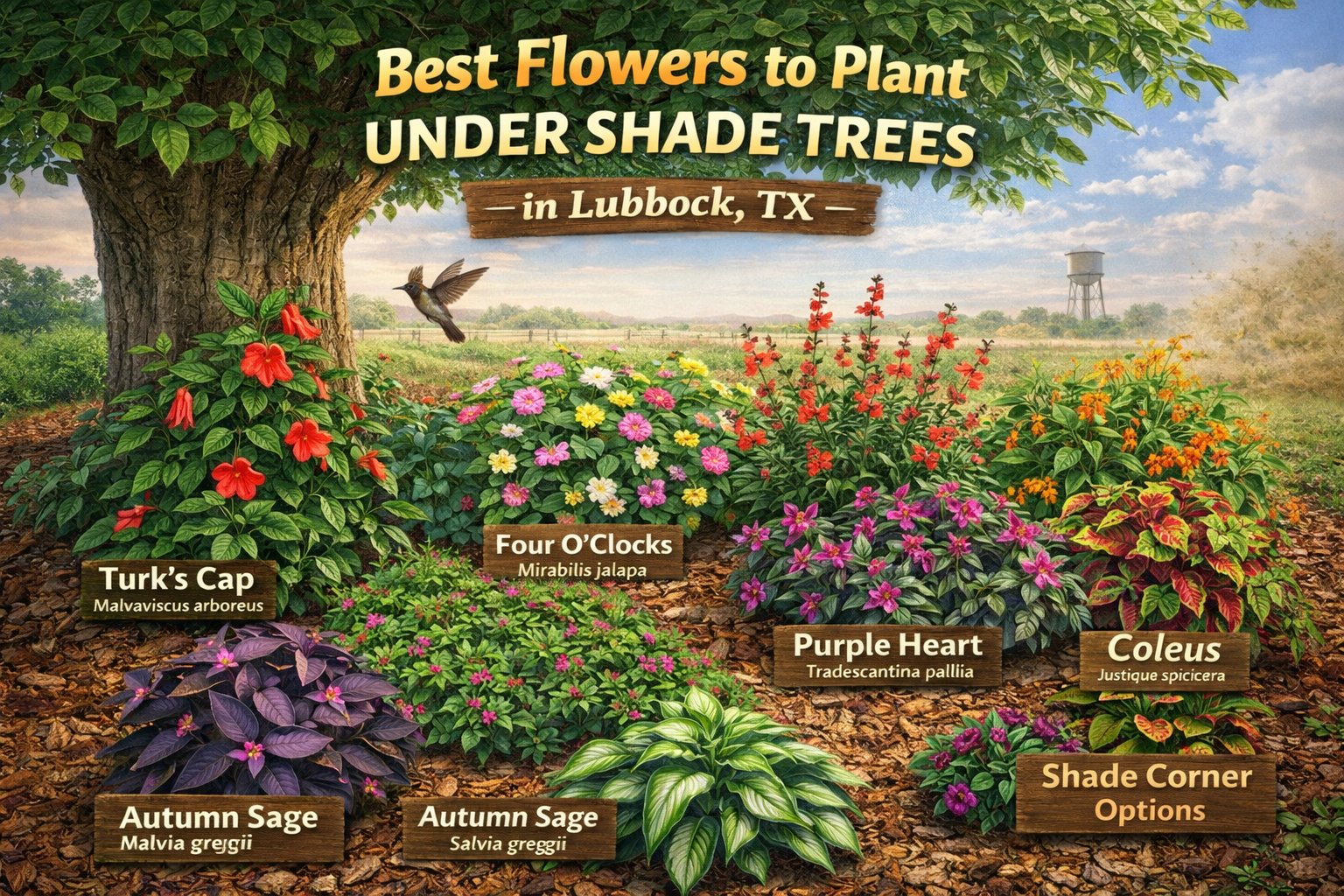
If you've got a big mulberry, elm, or mesquite tree dominating your front yard in Lubbock, you know the challenge. That tree is drinking most of the water, casting heavy shade, and the soil underneath is a web of roots competing for every drop of moisture. Planting flowers under it feels like setting them up to fail.
But it doesn't have to be that way. The right flowers — chosen specifically for Lubbock's alkaline soil, Zone 7b winters, and brutal summer heat — can thrive under shade trees and come back year after year. No replanting every spring. No babying annuals that fry in July.
Here are the perennials and tough groundcovers we recommend for under shade trees across the South Plains.
The Challenge: Why It's Hard
Planting under a mature tree in Lubbock means dealing with four things at once. First, dense shade — a mature mulberry canopy blocks 70-80% of direct sunlight. Second, root competition — tree roots occupy the top 12-18 inches of soil and absorb water and nutrients before smaller plants can get to them. Third, alkaline soil — Lubbock's soil pH typically runs between 7.5 and 8.5, which limits what can grow. And fourth, extreme heat — even in shade, ambient temperatures reach the upper 90s and low 100s in summer.
That's why generic shade-garden advice from gardening websites (written for places with 40+ inches of rain and acidic soil) doesn't work here. You need plants bred for or adapted to the specific conditions of West Texas.
Our Top Picks for Under Shade Trees
Turk's Cap
This is our number one recommendation for under shade trees in Lubbock. Turk's Cap is a Texas native shrub that produces red, pink, or white twisted flowers from late spring through the first frost. It thrives in full shade to part shade, is drought-tolerant once established, and handles alkaline soil without complaint. It dies back to the ground after a hard freeze but returns reliably every spring. The flowers attract hummingbirds, and the small red fruit that follows attracts songbirds — making it a great pick if you've got kids or grandkids who enjoy watching wildlife.
Four O'Clocks
An old-fashioned Texas pass-along flower that your grandmother probably grew. Four O'Clocks bloom in pink, magenta, yellow, and white — and here's the fun part: the flowers open each afternoon around 4 PM and stay open through the night, closing again in the morning. Kids love watching them "wake up" every evening. They grow from tuberous roots that survive Lubbock winters underground, coming back bigger each spring. They handle shade, heat, drought, and poor soil. They also reseed freely, so you'll have more each year without doing a thing.
Autumn Sage
A Chihuahuan Desert native that's perfectly at home in Lubbock. Autumn Sage produces tubular flowers in reds, pinks, corals, and even white from spring through fall — one of the longest bloom seasons of any perennial in our area. It's best on the sunnier edges of your tree's canopy (where it gets 4+ hours of sun), but handles dappled shade well. Extremely drought-tolerant, loves alkaline soil, and attracts butterflies and hummingbirds. Grows 2-3 feet tall and comes back reliably for years.
Purple Heart
If you want bold color without flowers doing the heavy lifting, Purple Heart delivers. The foliage itself is a striking deep purple, with small pink flowers appearing throughout summer. It spreads as a low groundcover (6-12 inches tall), filling in bare spots under trees beautifully. It's practically indestructible in Lubbock — handles shade, full sun, drought, and poor soil. It freezes back in winter but returns aggressively from the roots each spring. The purple foliage looks stunning against brown wood chip mulch.
Mexican Honeysuckle
A shade-loving shrub that produces clusters of bright orange tubular flowers almost year-round in mild years. It's drought-tolerant once established, handles Lubbock's alkaline soil, and hummingbirds are drawn to it like a magnet. It can freeze back to the ground in a hard Lubbock winter (below 20°F), but typically regrows from the roots in spring. Plant it on the outer edges of your shade area where it gets a little morning light and it'll reward you with nearly constant color.
Inland Sea Oats
Not a flower in the traditional sense, but this ornamental grass is one of the best shade-tolerant plants for Lubbock. It grows 2-3 feet tall with graceful arching stems and distinctive flat seed heads that dangle like little fish — kids find them fascinating. It's a Texas native, handles deep shade and dry soil, and adds beautiful movement and texture to the area under a tree. It turns golden brown in fall and can be left standing for winter interest or cut back in early spring.
Blackfoot Daisy
A low-growing Texas native that produces cheerful white daisies with yellow centers from spring through fall. It only reaches about 12 inches tall and wide, making it perfect for the front border of your bed around the tree. It does best in the brighter spots (dappled shade to part sun) and is one of the most drought-tolerant flowering plants available. It's evergreen in mild winters and handles alkaline, rocky, or caliche soil — basically, the worse the soil, the better it seems to do.
Bonus: Fun Annuals for Grandkids
If you're planting with grandchildren and want some instant color gratification (perennials can take a season to really fill in), mix in a few annuals that handle Lubbock shade. These won't come back next year, but they're cheap, easy, and give kids the satisfaction of seeing flowers fast.
- Coleus — wild, colorful foliage in every color combination imaginable. Kids love picking out the craziest colors at the garden center. Thrives in shade. Just pull them out after the first freeze.
- Impatiens — classic shade annual with bright flowers. Needs more water than the perennials on this list, but if your irrigation covers the bed, they'll bloom all summer.
- Caladiums — big, tropical-looking leaves in pink, white, red, and green. Grown from bulbs — plant in May once soil is warm. They can be dug up and stored over winter, or just buy new bulbs each spring.
Planting Tips for Under Trees
The golden rule: Don't fight the tree. The tree was there first, its roots own the soil, and it's not going anywhere. Your goal is to tuck plants into the spaces between roots and give them just enough of a head start to coexist — not to compete.
How to plant around tree roots
Dig carefully. Use a hand trowel rather than a full-size shovel. When you hit a major root, move over a few inches and try again. Never cut roots larger than 2 inches in diameter — you can seriously damage or destabilize the tree.
Amend each hole individually. Don't try to till or amend the entire bed — you'll destroy the tree's root system. Instead, dig each planting hole about twice the width of the plant's container, mix in a handful of compost with the native soil, and plant. This gives each flower a small pocket of improved soil to get started in.
Mulch 2-3 inches deep. Wood chips or shredded hardwood mulch between the plants will hold moisture, moderate soil temperature, and suppress weeds. Keep mulch pulled back a few inches from the trunk of the tree to prevent rot.
Water more at first, less over time. New plantings under a tree need supplemental water for the first 4-6 weeks while they establish roots. After that, the perennials listed above should be able to share the tree's water supply. A soaker hose laid through the bed under the mulch works great — it delivers water slowly at soil level where the roots can use it.
Layout tips
Think in layers. Put the tallest plants (Turk's Cap, Mexican Honeysuckle) toward the back or closer to the trunk. Medium plants (Four O'Clocks, Autumn Sage, Inland Sea Oats) in the middle zone. Low groundcovers and border plants (Purple Heart, Blackfoot Daisy) along the front edge near your stone border. This creates depth and makes a small bed look fuller.
When to Plant
The best time to plant perennials under shade trees in Lubbock is mid-March through April or September through mid-October. Spring planting gives them the growing season to establish before summer heat, while fall planting lets them put down roots during cool weather before going dormant for winter. Avoid planting in June through August — the combination of heat, dry air, and root competition is too much for new transplants.
For the annuals (coleus, impatiens, caladiums), wait until after the last frost — typically mid-April in Lubbock — and plant once nighttime temperatures are consistently above 55°F.
Need Help Designing Your Shade Garden?
At 3D Landscaping and More, we help Lubbock homeowners turn the bare, dry patches under their trees into beautiful, low-maintenance beds. We'll assess your specific tree and soil conditions, recommend the right plants, handle the installation, and set up mulch and irrigation so everything thrives.
Let's Transform That Shady Spot
Get a free quote for shade garden design, flower bed installation, and mulch work anywhere in the Lubbock area.
Request a Free Quote